
Optimisers for Solis inverters: design rules and commissioning
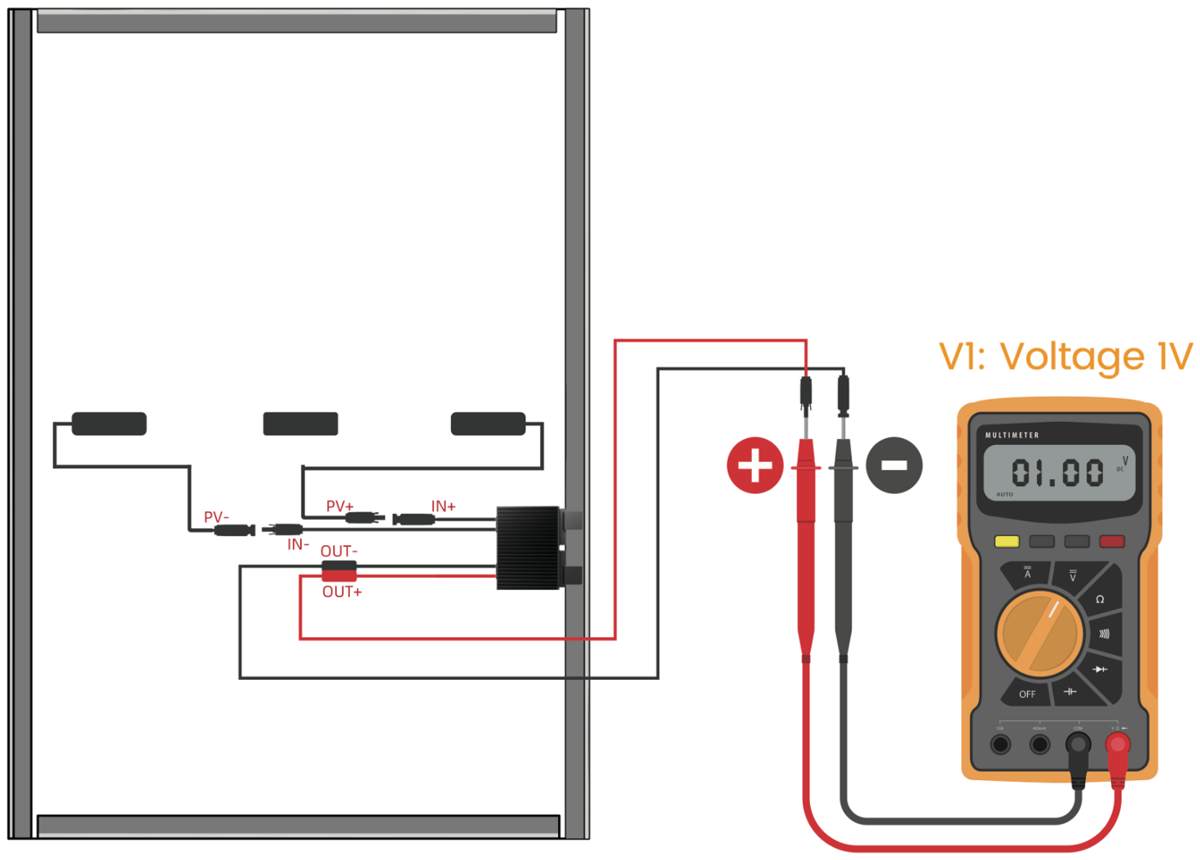
Short answer: yes. Archai iOPT 800W optimisers are certified for use with Solis inverters, under an official compatibility certificate issued in September 2025. You design the string to the Solis inverter exactly as you do now, then add four quick checks per panel and one GT gateway per string. At commissioning, each optimiser reads about 1 V until the gateway brings the string up, which gives you a simple pass or fail test at every panel.
This guide takes you from design to handover on a Solis job: the rules, a worked example on a Solis single-phase hybrid, and the readings to expect on site.
Why fit optimisers to a Solis inverter?
Solis inverters already track the maximum power point on each MPPT input. What they can't do is track each panel. On a string with a chimney, a dormer or a tree in the way, the shaded panel drags the whole string to a compromise operating point. A panel-level optimiser gives every panel its own MPPT, so shade on one panel costs that panel's output and no more.
On our side-by-side test in Stockport, the optimised string produced 10% more with one panel shaded and 17% more under moving shade. The full case study has the method and the numbers.
You also get two things a Solis inverter can't give on its own: panel-level monitoring in SolarSync, and rapid shutdown to a safe 1 V at every panel. And because you keep the Solis inverter, you keep your supply chain, your stock and the setup process you already know. See how the parts fit together on the system page.
The design rules on a Solis job
These are the same four rules as on any Archai job:
- One iOPT 800W per panel. Every panel in the string gets an optimiser.
- One GT gateway per string, up to 30 optimisers. Two MPPT inputs with one string each means two GTs.
- Every panel inside the optimiser's input limits: 800 W max power, 70 V max input voltage (check Voc), 23 A max short-circuit current (check Isc), and an MPPT range of 12–60 V.
- A certified inverter. Solis is certified. If the job is on anything other than Solis or Fox ESS single-phase, ask us first.
Then do your normal inverter-side design with the panel datasheet: string voltage at your coldest design temperature against the Solis maximum DC input voltage, operating voltage inside the MPPT range, and current against the per-MPPT limits. Adding optimisers doesn't change those checks. Follow the design and documentation requirements of MCS MIS 3002 and the current wiring regulations, now BS 7671:2018+A4:2026, which replaced the A2+A3 version after a six-month transition.
Worked example: a Solis 5 kW hybrid with a shaded front roof
The job: a semi-detached house with 14 × 440 W panels. Eight go on the south-facing front roof, where a chimney shades two panels in the morning. Six go on the west-facing rear roof. The inverter is a Solis S5-EH1P5K-L single-phase hybrid with a battery.
The Solis figures below come from the Solis UK technical brochure for the S5-EH1P(3-6)K-L range. The panel figures are an example; use the datasheet for the panel you're fitting.
| Check | Value | Limit | Result |
|---|---|---|---|
| Panel power | 440 W | 800 W (optimiser) | ✓ |
| Panel Voc at −10 °C | 43.0 V | 70 V (optimiser) | ✓ |
| Panel Isc | 14.0 A | 23 A (optimiser) | ✓ |
| Panel Vmp | 33.0 V | 12–60 V (optimiser MPPT) | ✓ |
| String 1 cold Voc (8 panels) | 344 V | 600 V (Solis max input) | ✓ |
| String 1 Vmp (8 panels) | 264 V | 90–520 V (Solis MPPT range) | ✓ |
| String 2 Vmp (6 panels) | 198 V | 90–520 V (Solis MPPT range) | ✓ |
| Isc per MPPT | 14.0 A | 22.5 A (Solis max short-circuit) | ✓ |
How the numbers work. The example panel has a Voc of 39.5 V and a Voc temperature coefficient of −0.25%/°C. At −10 °C the cell is 35 °C below standard test conditions, so Voc rises by about 8.75%, to 43.0 V. Eight in series gives 344 V. Both strings sit comfortably inside the Solis window, and each goes on its own MPPT input because the two roofs face different ways.
Bill of materials: 14 × iOPT 800W and 2 × GT, one for each string. Not one GT for the whole system, and not optimisers only on the two shaded panels.
For a longer walk-through of the same method, see designing a string with optimisers.
Installing: the order that matters
With the Solis DC isolator off and the array disconnected:
- Clip an optimiser behind each panel. Connect IN first, then OUT. When removing one later, it's OUT first, then IN.
- Connect the panel's + and − to the optimiser's IN+ and IN−. Push each Stäubli MC4 home until it clicks, then tug-test. Never mate it with another brand of connector.
- Chain the outputs: OUT+ of each optimiser to OUT− of the next.
- Mount the GT near the Solis inverter. The last OUT+ goes to the inverter's PV+. The first OUT− goes through the GT's magnetic ring to the inverter's PV−.
- Connect the GT's AC lead (L16-2 connector) to a 90–264 V supply through an MCB. Label that MCB clearly: removing the GT's AC supply puts every optimiser into shutdown.
The GT is rated IP67, so it doesn't need an enclosure. More detail is in the installer course, and our article on rapid shutdown at panel level explains what the 1 V state means on the roof.
Commissioning: the 1 V test
Before the GT is live, each optimiser holds its output at about 1 V. That makes faults easy to find with a multimeter.
| Reading | What it means | Action |
|---|---|---|
| 0.9–1.1 V at one optimiser's OUT | Normal | Carry on |
| Above 1.1 V | Faulty optimiser | Replace it |
| Below 0.9 V | Low light or an IN wiring fault | Check the light and IN wiring; if it's still low, replace it |
| About −1 V | Meter probes reversed | Swap the probes |
| String reads about 1 V × number of optimisers | Normal | Carry on |
| String reads higher than expected | A panel wired straight into the string, or extra optimisers | Find the panel without an optimiser |
| String reads lower than expected | An IN or OUT not connected, or an OUT reversed | Check each optimiser |
| String reads 0 V | Open circuit, or cable on the wrong string | Trace the string |
In our example, string 1 should read about 8 V and string 2 about 6 V in good light. That's well below the Solis S5-EH1P start-up voltage of 120 V, so don't expect the inverter to wake up yet. It starts once the GT brings the optimisers out of the safe state.
Then power up:
- Turn the Solis DC isolator on.
- Power the GT. The Power and Running lights come on.
- Press the GT button once. After 5 seconds, press and hold until lights 2–4 flash, then release.
- Wait about 10 minutes. A flashing Running light means the self-test passed.
- Press once more so Running stays on.
If the self-test fails three times, stop and call our technical support team.
Monitoring and handover
Map each optimiser in SolarSync (Layout, then Add, then set its row and column from your layout sheet). Green means working, grey means offline and red means failed. The data reaches the GT over the DC cable itself, using power line communication, so there's no Wi-Fi on the roof to drop out. The Solis monitoring carries on as normal for the inverter and battery.
Leave the customer with SolarSync set up on their phone, the layout sheet, the datasheet and the 25-year optimiser warranty, and keep a copy of the layout sheet in your job file.
Frequently asked questions
Can you fit optimisers to a Solis inverter? Yes: Archai iOPT 800W optimisers are certified for use with Solis inverters under a compatibility certificate issued in September 2025.
Do I need to change any settings on the Solis inverter? Our install guide doesn't call for any Solis-specific settings: set up the inverter as you normally would, then commission the GT as described above.
How many GT gateways do I need on a two-MPPT Solis inverter? One GT per string, so two strings on two MPPT inputs need two GTs.
Why won't the Solis inverter start before the GT is commissioned? Each optimiser holds about 1 V until the GT is live, so a 10-panel string shows about 10 V, which is below the Solis start-up voltage.
Do optimisers work with Solis hybrid inverters and batteries? Yes: optimisers sit on the DC side between the panels and the inverter's PV input, so the battery side of a Solis hybrid is unaffected.
Quote your next Solis job with Archai
If you fit Solis already, adding Archai is mostly a bill of materials change. Send us the design before you quote and we'll check it, especially for long strings, mixed panels or high-current modules. You can see where every inverter stands on our partners page and in will Archai work with my inverter?.
Installers and stockists can join the partner programme for trade pricing, ready-matched Solis kits and design support. Or talk to us about a specific job.
Spec Archai on your next job
Datasheets, trade pricing and compatibility checks for installers and distributors.