
Rapid shutdown at panel level: what it actually means on a UK roof
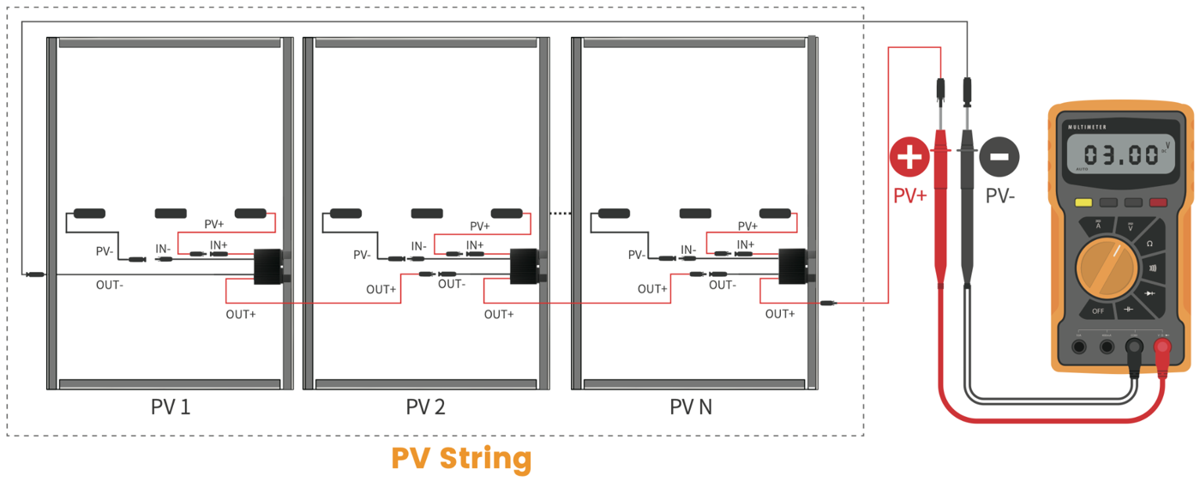
A solar array can't be switched off by turning off the inverter. As long as there's daylight, every panel in a string keeps producing voltage, and in a series string those voltages add up. Isolate the inverter and the DC cables running across the roof and down through the building are still live.
That's the problem panel-level rapid shutdown solves. In this post we explain what it does, what the numbers look like on a typical UK install, and how to prove it's working before you leave site.
The numbers on a normal string
Take a common residential job: 14 panels at 450 W, each with an open-circuit voltage (Voc) of 49.5 V, wired as one string. With the inverter isolated, that string sits at roughly 14 × 49.5 V, so close to 700 V DC. On a cold, bright morning it can be higher, because panel voltage rises as temperature falls.
That voltage is present on the roof, in the loft and at the inverter's DC terminals whenever there's light. It's a risk for anyone working on the system, and for anyone dealing with the building in an emergency.
What rapid shutdown does
With an Archai iOPT 800W optimiser behind each panel, every module has its own switch. When the system is told to shut down, each optimiser drops its output to a safe 1 V (0.9–1.1 V). The same 14-panel string now reads about 14 V end to end instead of about 700 V.
Shutdown is controlled by the Archai GT gateway, which sits in series between the string and the inverter. There are two ways to trigger it:
- Press the RSD button on the GT until the RSD light comes on.
- Remove the GT's AC supply. If the AC goes, the optimisers drop to 1 V within about 30 seconds, and all four lights on the GT go out.
The second point matters. It means that if the building's supply is switched off at the consumer unit, the array also makes itself safe. Nobody has to remember a separate step.
How to check it on site
This is the part we'd encourage every installer to build into their routine. It takes a multimeter and a couple of minutes.
- Each optimiser on its own: after connecting the panel to the optimiser's IN leads, measure OUT+ to OUT−. You should see about 1 V (0.9–1.1 V). More than 1.1 V means the optimiser is faulty; less than 0.9 V usually means low light or an input wiring fault. About −1 V means your probes are the wrong way round.
- The whole string: once the outputs are chained, measure the string in good light. You should see about 1 V × the number of optimisers. Fourteen optimisers, about 14 V.
- After commissioning: with the GT powered and the system running, press RSD and measure again at the inverter's DC input. You should be back to the low-voltage reading.
If a string reads 0 V, there's an open circuit somewhere in the chain. If it reads lower than expected, an optimiser's IN or OUT is likely disconnected or reversed.
Where the rules are heading
There's no direct UK equivalent of the US rule that requires rooftop rapid shutdown on new systems. But fire safety on rooftop PV is getting more attention here, and being able to show that the DC side of a system can be brought down to a few volts is a straightforward answer to a fair question from a customer, a landlord or an insurer.
The short version
Without panel-level shutdown, a string stays at full voltage whenever there's light. With it, every panel drops to 1 V, the string drops to a handful of volts, and you can prove it with a meter in under a minute.
If you'd like to see it working, ask us for a demo or take the free Archai installer course. It covers commissioning and testing step by step.
Spec Archai on your next job
Datasheets, trade pricing and compatibility checks for installers and distributors.