
How solar optimisers work, and when they're worth fitting
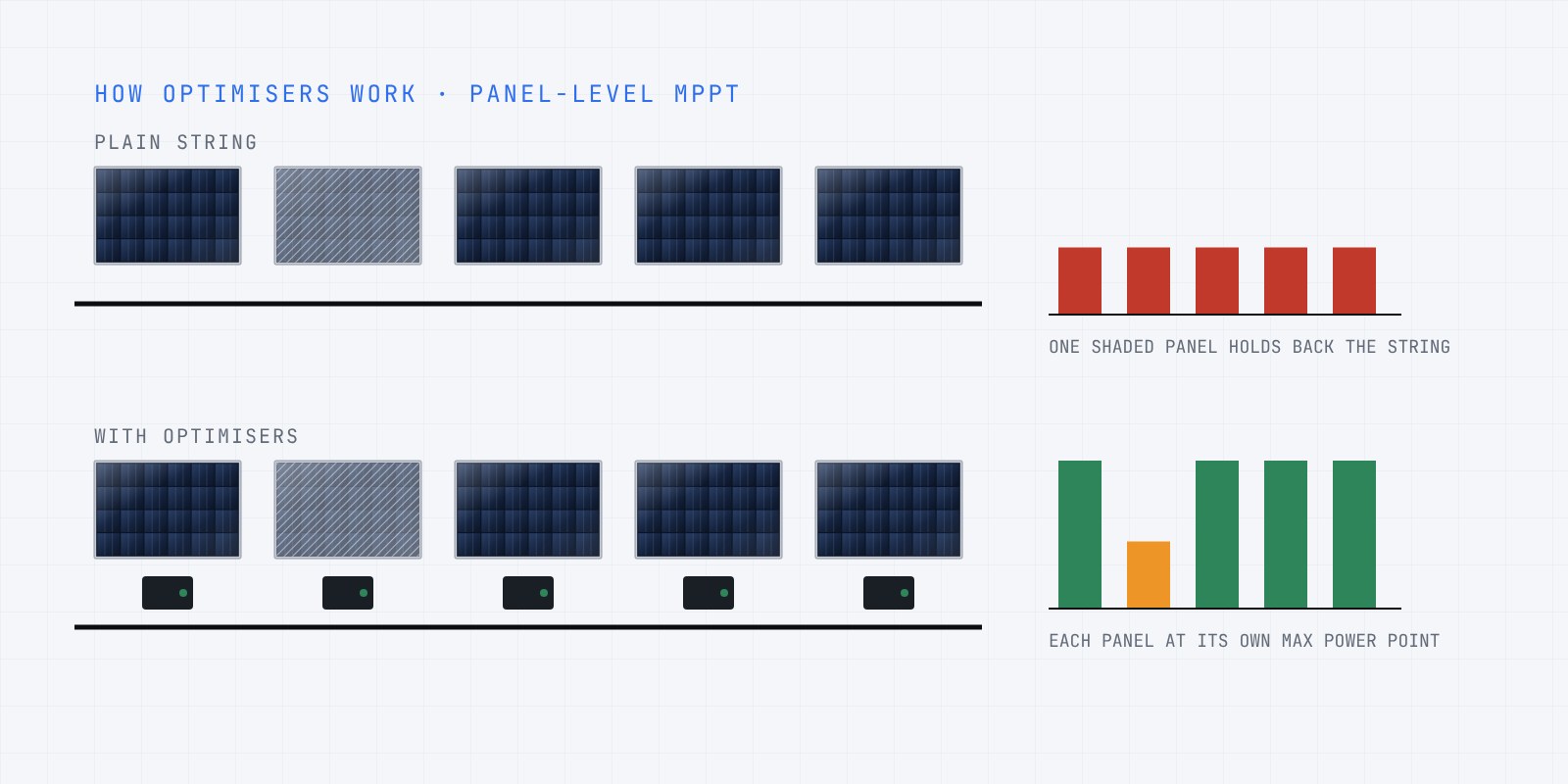
In a standard solar system, panels are wired in series as a string. That's simple and efficient, but it has one weakness: every panel in a string has to carry the same current. When one panel can't keep up, the whole string is affected.
Panel-level optimisers remove that weakness. This post explains how they do it, and, just as importantly, when they're worth fitting and when they aren't.
The weakest-link problem
A panel's current depends on how much light reaches it. Shade a single panel with a chimney, a dormer or a neighbour's tree and its current drops. In a series string, the inverter then has two poor choices:
- Run the whole string at the shaded panel's lower current. Every unshaded panel is held back.
- Let the shaded panel's bypass diodes switch in. Its output is skipped entirely, and the string voltage drops.
Either way the string loses more energy than the shaded panel alone was responsible for. The same thing happens, less dramatically, with dirt on one module, panels facing different directions on the same string, or panels that have aged at different rates.
What an optimiser does
An optimiser is a small DC-to-DC converter fitted behind each panel. It does two jobs:
- Panel-level MPPT. Each optimiser finds its own panel's maximum power point and holds it there, whatever the other panels are doing.
- Current matching. It converts that power to whatever voltage and current the string needs, so a shaded panel contributes what it can without dragging down the rest.
The inverter still does its normal job of converting DC to AC. Its own MPPT keeps working too; it just sees a string that's no longer being held back by one weak panel.
Where optimisers make a real difference
- Partial shade from chimneys, dormers, aerials, trees and neighbouring buildings. On UK roofs this is the norm, not the exception.
- Split orientations, such as east/west roofs or panels across more than one pitch.
- Mismatch between panels: soiling, ageing, or replacement panels added later.
- Panel-level safety and data. Even on a clean, unshaded roof, optimisers add rapid shutdown at each panel and per-panel monitoring, which some customers want for their own sake.
On our Stockport install, carried out as part of our Solis certification, post-installation testing showed a consistent 10–15% uplift on the shaded strings compared with the baseline. You can read the full case study.
Where they make less difference
On a roof with one orientation and no shade at all, the yield gain from optimisers is small, because there's little mismatch to recover. The case for fitting them there rests on rapid shutdown and panel-level monitoring rather than extra energy. We'd rather say that plainly than promise every roof a big uplift.
How the Archai system fits together
- iOPT 800W optimiser behind each panel: panel-level MPPT up to 800 W, ≥ 99.7% peak MPPT efficiency, rapid shutdown to 1 V.
- GT gateway, one per string of up to 30 optimisers, in series between the string and the inverter. It collects data from the optimisers over the DC cable (PLC) and passes it to SolarSync.
- SolarSync app and desktop, showing every panel's output live, with alerts.
It works with Solis inverters and Fox ESS single-phase inverters. See where we stand on compatibility for the detail.
The short version
Optimisers stop one weak panel from setting the pace for the whole string. On shaded, split or mismatched roofs, which is most UK roofs, that recovers real energy. On a perfect roof, the benefit is mainly safety and visibility.
If you'd like us to look at a specific roof, talk to us.
Spec Archai on your next job
Datasheets, trade pricing and compatibility checks for installers and distributors.